

All I see are ghosts
All I see are ghosts, and my mind tries to cast these faces from my past onto strangers on the street

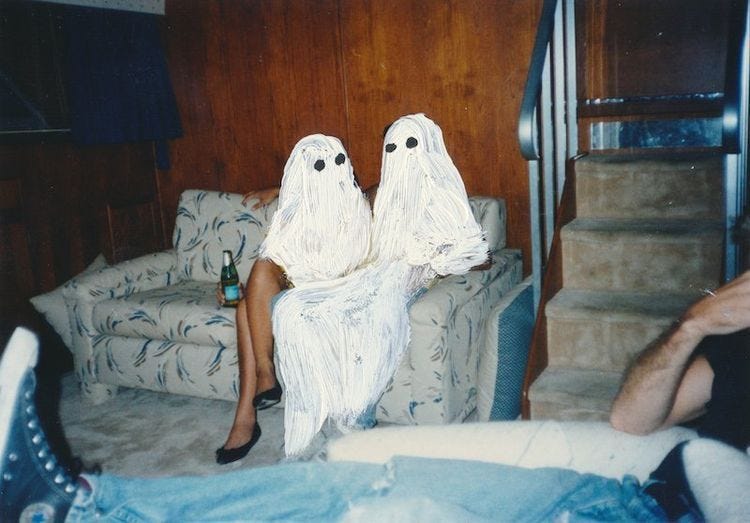
Near my office, there is a circle of trees on a hill.
It seems strange and quietly remarkable that such a thing could puncture the grit and grime of East London. I often walk there at random intervals throughout the day. Sometimes with company, but often alone, to step away for a moment of fresh air or a quick cry.
On walks, generally, I have a tendency to fade into my own thoughts, even when with others. The habit has only worsened since I moved to a city where I no longer recognize people on the street; there is no one for me to know, or to know me, here.
All there is for me to see are ghosts, and my mind tries to cast these faces from my past onto strangers I see on the street.
Reading Italo Cavino’s Invisible Cities, the narrator, Marco Polo, reaches a city where although he is visiting for the first time, every person he meets wears a face from his past.
Whether they are stranger, or memory, or friend, is not quite clear:
“The vegetable vendor raised her face: she was my grandmother. I thought: “You reach a moment in life when, among the people you have known, the dead outnumber the living. And the mind refuses to accept more faces, more expressions: on every new face you encounter, it prints the old forms, for each one it finds the most suitable mask.”
Certainly, Cavino makes a point about grief, an idea I am lucky enough not to understand much of yet. I am still at a point where my family, my friends, the small circle of my life are all alive and well.
Nevertheless, I recognized myself in the experience he describes; the almost stubborn refusal of my mind to process that I am in a new place, to accept new faces, despite the inherent knowledge that it must be true. Instead, I look to print the old on the faces of strangers, to find them the most suitable mask.
By no stretch would I say that it is conscious. Nor would I say that it is linked to people I even miss presently.
I do see people that I care for: the red sheen of my mother’s hair in a woman commuting, the thick braid of my best friend’s when hers was at its longest, the shape of another older man’s cane in a restaurant is my grandfather’s before he passed.
Yet there are also those I see in crowds that I’ve never cared for or known at all, beyond that they were once a person with whom I shared space. The square shoulders of a strong swimmer I went to high school with and never spoke to, the purple flounce of a skirt on a child is someone in a grade school class, though I can’t quite remember her name.
When I caught onto these strange flashes, it became a game I played—who are you, to me?
It is a dangerously self-centered coping mechanism, I know. In my heart, I am more than aware that everyone belongs to themselves, and to those that love them.
I tell myself it’s harmless, a ghost there and then not, as harmless and lovely and fleeting as the Northern lights. But I also wondered if I was alone in this search.
Because I am a researcher by training if not trade, and the daughter of scientist by training if not trade, I turned to texts to see if there was any scrap of truth to this phenomenon.
Of looking for faces you know are not there.
It turns out there are a few things.
There’s heuristics, which is the process by which humans use shortcuts to arrive at decisions. After visual input, it may be quicker to arrive at a face you know than process the new visage of a stranger you don’t. There is also research that reflects that faces perceived as “attractive” might be inherently more familiar to us, which might make me even more shallow than I could have possibly imagined.1 Luckily for me, there’s a great deal of variance.2
There’s also apophenia, which is the tendency or instinct to perceive meaningful connections between unrelated things.3 Think along the lines of a contrarian argument to Jeff Goldblum’s chaos theory speech in the original Jurassic Park.
But I think there is something nice about the fact that humans exert so much time and energy looking for order in the chaos. Or, more poetically, figures in the clouds.
The first time I did recognize a face in London, properly, I was on one of my walks to the hill. I had left my office alone, and therefore had not expected to run into anyone. Why would I?
Coming around a corner, I thought I heard the shape of my name, but ignored it.
“Elle,” is a sound that can sound like nearly anything: wind at the right angle, the clatter of a truck, even a whoop of laughter from a passerby. It is one of those single syllables that, while I claim it as my own when relevant, could really belong to anyone at any given time.
But I heard it again, this time yelled sharper and more directive. I looked up and saw two girls from my office, looking at me and waving. They had come after me to try and catch up, so we could all walk together.
After a moment, they started to laugh. “What’s wrong?” one asked.
“Honey, you look like you’ve seen a ghost,” said the other. It was a sunny afternoon, and they didn’t quite understand, of course. To them, I just looked lost in thought.
“Nothing,” I said. “Nothing,” I tried again, tried to swallow it all; how being looked for, and called to, and found for the first time in two years made me feel. Like I had suddenly grown roots on the spot, there in the leaves on the pavement.
I blinked and willed the moment to wash away. “You just surprised me. Let’s walk.”
One time, years ago now, while working in the bookstore of my hometown after graduating college, a boy I went to middle school with came up to my register.
Or, perhaps I shouldn’t say boy, or girl. By then he was a man, and I a woman. He and I played on the school basketball teams at the same time, at thirteen and fourteen.
I started to ring him up when he said, “I know you, don’t I?”
Even now, I couldn’t say why I did it when I knew exactly who he was: his name and his older sister and the position he played. But I said, “I don’t think so.”
“No,” he insisted as I bagged up his items. “We went to high school together, didn’t we?”
When he said this, I had thought I found my out; I had left our school district the year after we had played basketball at the same time, and we had never attended high school together.
“I didn’t go to high school in this town,” I said. “You must be thinking of someone else.” With that, certain I’d won, I handed him his bag.
“No,” he said, refusing to let me get away with it. His face was almost scrunched with concentration, I could see he was searching for my name in the recesses of his memory. He failed, ultimately, but said. “I remember your eyes. I don’t think I could forget those eyes.”
He was right; my eyes, big and owl-like and gray blue, are the most distinct thing about me. My heart dropped into my stomach, but he said no more. He took his bag and left the store, and I never saw him again.
Looking back, it seems like a little cruelty I wish I could undo. I turned myself into his ghost, for no good reason at all.
A more specific version of apophenia is pareidolia, which can be defined in a gross oversimplification as finding patterns where there are none. Specifically, faces: on the moon, in an ink splatter, in the clouds, on the drips of water on a wall, in a cactus climbing a cliff face.
This is no new phenomenon. Take a very sane Hamlet, for instance:
Hamlet: Do you see yonder cloud that’s almost in the shape of a camel?
Polonius: By th’Mass and ‘tis, like a camel indeed.
Hamlet: Methinks it is a weasel.
Yet while this reflects faces in many strange places, it doesn’t allude to the lowest hanging fruit: searching for faces in faces.
The most apt phenomena, perhaps then, is recognition memory, which is the ability to recognize the things you come across. However, experientially, this can break down further into two categories: recollection and familiarity, or more colloquially, “remembering” and “knowing”.4 This breaks down into several functions across several parts of the brain, but the premise is the same in that humans can subconsciously or consciously recall past people, places, things, etc.
So my little game has quite a neural basis. What I’d call hunting for ghosts, the more scientific-minded might call desperately seeking pattern recognition.
Or perhaps, a commitment to remembering and a refusal of knowing.
The second time I recognized someone in London, it was one of those moments where time slows down a bit.
I had forgotten what that had felt like, and thought it a type of occurrence mostly reserved for romantic comedy movies where time slows down, but it happened at 8:43am on a cold Tuesday commute.
She was getting on the train, and I was getting off. How startled we both were to find each other 3,500 miles from where we’d left one another.
My first year of college, we were close friends. People even said we looked alike.
Spring break of 2018, we were in San Francisco together with a few of our friends. The fun we had, at nineteen and fearless and tireless. All of us ate little else besides thick, warm burritos. We danced constantly. We laid in wet grass, watching the fog rumble over hills, backlit by the setting sun, until it grew dark.
I remember walking on the beach, our red-brown hair in wild flight. There’s a wonderful photo of her and I and my best friend, squeezing each other close, with the expanse of the Pacific as our backdrop. Her brother took it far away, so we look like three penguins huddled and interlocked against the elements.
Nothing remarkable happened—COVID descended, and we grew apart, but we’d always say hello when we eventually came back to campus. We never grew close again, but it was always nice to see her.
But at some point, we stopped talking. This is unremarkable; there are thousands, millions perhaps, of friends from college that you don’t speak to but think of fondly.
That you wish well from a distance.
Until the distance is a thick chunk of glass on the Elizabeth line.
I waved, and she waved, and we both smiled, and that was it.
No ghosts at all.

this made me sad. I have known so many people over the years and have had really mice moments with them but have lost touch. it’s not cuz of vindictive reasons, just no proper reason to stay in contact anymore or cuz of just distance and other commitments 🫠🫠🫠🫠🫠
Such a lovely, unusual read :)